- Published on
- • 7 min read
Vercel AI SDK and NodeLLM: Choosing the Right Layer
- Authors

- Name
- Shaiju Edakulangara
- @eshaiju
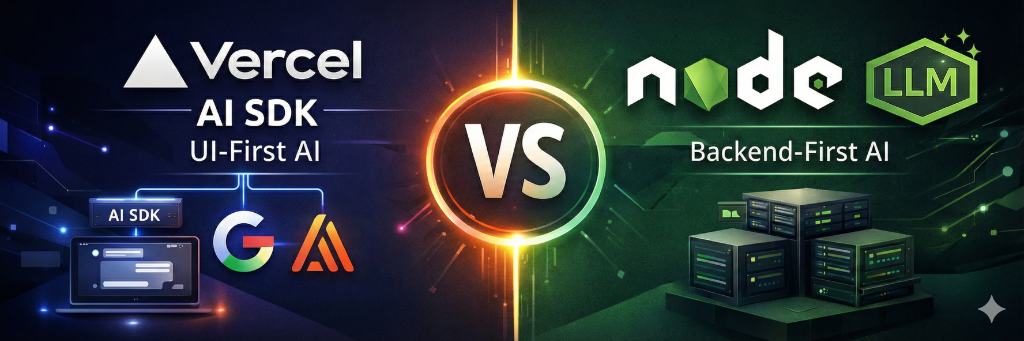
If you’re building an AI app today, you’re likely taking a serious look at the Vercel AI SDK. It is an incredible piece of engineering: it standardises the chaotic world of LLM APIs and makes building streaming chat interfaces surprisingly simple.
For 90% of developers building chat apps, it is the right choice.
However, engineering is rarely about "best" or "worst"—it is about trade-offs.
I built NodeLLM (@node-llm/core) because I found myself needing a different set of trade-offs. I wasn't just building a chat UI; I was responsible for backend worker queues, reliable automation pipelines, and rigorous testing environments. I needed something that felt less like a frontend toolkit and more like a database driver.
Here is a factual look at where these two libraries diverge in philosophy and architecture.
What NodeLLM Offers Today
Before diving into the comparison, here's what NodeLLM brings to the table in its current release (v1.10.0):
- 540+ Models: Unified API across OpenAI, Anthropic, Gemini, DeepSeek, AWS Bedrock, OpenRouter, and Ollama
- Middleware Architecture: Global and local interceptors with built-in PII masking, cost guards, and usage logging
- Extended Thinking: Native support for reasoning models (OpenAI o1/o3, Anthropic Claude 3.7, DeepSeek R1)
- Streaming + Tools: Automated tool execution loops that work seamlessly with streaming
- Type-Safe Structured Outputs: Full TypeScript intellisense with Zod schema validation
- ORM Persistence: Automatic tracking of chats, messages, tool calls, and API metrics
- VCR Testing: Record and replay LLM interactions for deterministic, zero-cost CI runs
1. Frontend-First vs. Backend-Native
Vercel AI SDK excels at the "edge." Its streaming primitives (useChat, StreamData) are designed to get the first token to the user's eye as fast as possible. It couples tightly with frontend frameworks to deliver a seamless UX.
NodeLLM makes the opposite trade-off: it assumes it is running deep in your backend infrastructure.
- It does not worry about React hooks or edge functions.
- It focuses on Process Protection: enforcing strict timeout windows so a hung provider doesn't stall your event loop.
- It prioritises Observability: ensuring every request, tool call, and retry is traced for backend logging systems.
- It provides a Middleware Architecture: global and local interceptors for PII masking, cost guards, and usage logging.
2. Middleware Architecture (New in v1.10)
NodeLLM now includes a standardized interception layer for LLM requests and responses:
import { createLLM, PIIMaskMiddleware, CostGuardMiddleware } from "@node-llm/core";

const llm = createLLM({
  middlewares: [
    PIIMaskMiddleware(),      // Automatically mask sensitive data
    CostGuardMiddleware({     // Enforce budget limits
      maxCostPerRequest: 0.50,
      maxTokensPerRequest: 4000
    })
  ]
});
This is particularly valuable for:
- Compliance: Automatic PII redaction before data leaves your infrastructure
- Cost Control: Hard limits on token usage and API costs per request
- Observability: Unified telemetry for token usage across all providers
3. Testing Strategies
In critical backend systems, testing cannot be an afterthought. You need to verify your agent's logic without incurring API costs or dealing with non-deterministic LLM responses in CI.
NodeLLM treats testing as a first-class citizen via the @node-llm/testing package:
- VCR Recording: Capture real provider interactions once and replay them instantly in CI for deterministic, zero-cost test runs.
- Time-Travel Debugging: Test timeout handling and rate-limiting logic deterministically.
- Fluent Mocks: Define precise expected tool call sequences without complex manual mocking.
- Middleware Testing: Test your middleware logic with mocked LLM calls (new in v0.4.0).
- Call History Tracking: Verify mock interactions with
getCalls()andgetLastCall()methods.
While it is possible to mock Vercel AI SDK calls using standard tools (like Jest or Vitest), NodeLLM provides these specialized AI testing primitives out of the box because it assumes testing is central to your development workflow.
4. Persistence: The "ORM" Approach
Vercel AI SDK is stateless by default. This is great for scalability, but most complex applications need memory. You often end up writing boilerplate to save message history to Redis or Postgres manually.
NodeLLM offers an optional @node-llm/orm layer. It allows you to treat a chat session essentially like a persistent object:
import { createChat } from "@node-llm/orm/prisma";

// This chat session is automatically saved to your database
// after every turn. No manual saving required.
const chat = await createChat(prisma, llm, {
  model: "gpt-4o",
  provider: "openai"
});

await chat.ask("What did we discuss yesterday?");
This automates the boring work of serialisation, history management, and context window truncation.
5. Extended Thinking & Reasoning Models
NodeLLM provides first-class support for reasoning-focused models like OpenAI o1/o3, Anthropic Claude 3.7, and DeepSeek R1:
// Access chain-of-thought reasoning
const res = await NodeLLM.chat("deepseek-reasoner")
  .withThinking({ budget: 10000 })  // Token budget for thinking
  .ask("Solve this logical puzzle");

console.log(res.reasoning);  // Full chain-of-thought
console.log(res.content);    // Final answer
This is critical for complex problem-solving where you need visibility into the model's reasoning process—something that's often hidden or inconsistent across providers.
6. Provider Coverage: 540+ Models
NodeLLM now supports 7 major providers with a unified API:
| Provider | Key Features |
|---|---|
| OpenAI | Chat, Streaming + Tools, Vision, Audio, Images, Reasoning (o1/o3) |
| Anthropic | Chat, Streaming + Tools, Vision, PDF, Extended Thinking (3.7) |
| Gemini | Chat, Streaming + Tools, Vision, Audio, Video, Embeddings |
| DeepSeek | Chat (V3), Reasoning (R1), Streaming + Tools |
| AWS Bedrock | Nova, Titan, Claude 3/3.5, Guardrails, Prompt Caching |
| OpenRouter | Aggregator for 400+ models with unified billing |
| Ollama | Local inference for privacy-sensitive workloads |
7. Architectural Stability
The Vercel AI SDK moves incredibly fast, shipping new features and support for new providers weekly. This is fantastic for innovation.
NodeLLM aims to be boring.
Its interface is designed to hide the churn of the AI ecosystem. Your business logic shouldn't need to change just because a provider released a new SDK version. By treating the LLM as a generic, swappable infrastructure component (like pg for Postgres), NodeLLM allows your application core to remain stable even as the models underneath shift rapidly.
Strategic Positioning: NodeLLM vs Vercel AI SDK
Vercel AI SDK and NodeLLM solve adjacent but fundamentally different problems.
Vercel AI SDK is an excellent frontend-centric framework: it optimizes for React, streaming UI hooks, and rapid product iteration, and has recently expanded into backend and agent workflows via AI SDK Core and ToolLoopAgent.
NodeLLM, by contrast, is a backend-first LLM runtime: it is designed around provider-agnostic contracts, standard async streams, persistence, evals, telemetry, and long-running AI agents — independent of any frontend framework or hosting platform.
A useful mental model:
Vercel AI SDK is a frontend framework that grew a backend.
NodeLLM is a backend runtime that happens to support the frontend.
Key architectural differences
| Feature | Vercel AI SDK | NodeLLM |
|---|---|---|
| Streaming | Exposes streaming via a proprietary protocol optimized for UI hooks | Exposes streaming as a standard AsyncIterator, suitable for workers, queues, and agents |
| Tool execution | Both support automated tool loops | NodeLLM’s implementation is backend-native and environment-agnostic |
| Persistence | Treats persistence as application-level boilerplate | Treats persistence as infrastructure via @node-llm/orm |
| Platform coupling | Integrates deeply with Vercel’s AI Cloud | Intentionally standalone and portable |
| Reasoning models | Basic support | First-class support with .withThinking() and .withEffort() |
| Provider coverage | Growing ecosystem | 540+ models across 7 providers including AWS Bedrock |
| Neither replaces the other — but they belong to different architectural layers. |
For many projects, the answer is both: Vercel for the frontend stream, and NodeLLM handling the complex background processing, testing, and persistence layers.